Mold Remediation in Fort Worth, TX
Inspection, testing, remediation, and post-remediation clearance for homes and businesses across Fort Worth and Tarrant County, coordinated through restoration professionals available day and night.
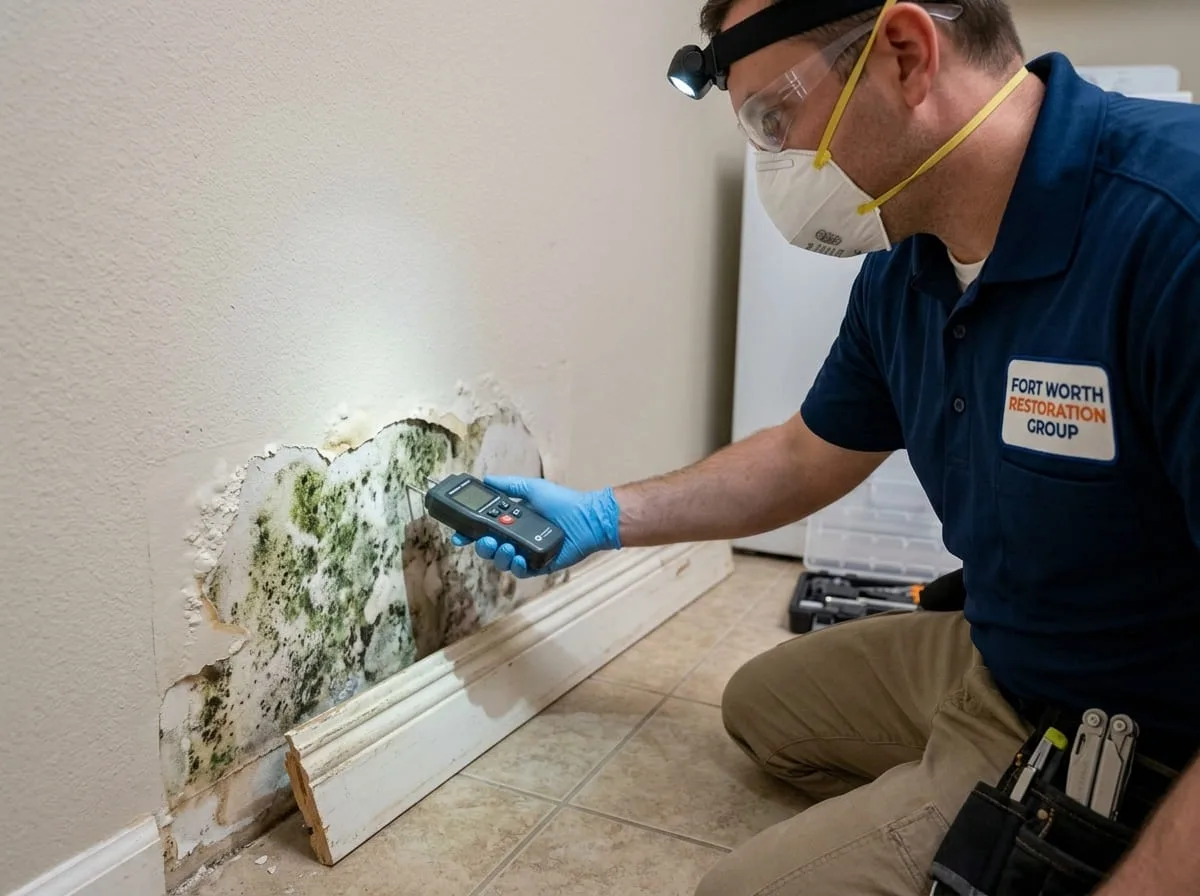
Mold problems in Fort Worth almost always start the same way: moisture sits somewhere longer than it should. That might be a slow supply line leak behind a cabinet, a roof leak that went unnoticed through a spring storm, or a pier-and-beam crawl space in one of the city's older neighborhoods that never quite dries out between rains. Add in North Texas's long, humid summers, and a water problem that isn't dried quickly has a real chance of becoming a mold problem as well.
This page covers the full scope of mold services available to Fort Worth property owners — inspection, air and surface sampling, containment and remediation, and post-remediation verification once the work is finished. Every call is routed to restoration professionals who assess the property, explain what they find in plain terms, and outline a scope of work before anything begins.
Because most residential mold traces back to a water event, mold and water problems are rarely separate issues on the ground. If there's an active leak, recent flooding, or a slow drip that's finally been noticed, the fastest way to a resolved mold problem is usually to deal with the water first.
Mold Remediation in Fort Worth, TX Services
Mold After Water Damage
The most common mold call in Fort Worth — moisture from a leak or flood that wasn't dried fast enough, now showing up as growth or odor.
Learn more →Crawl Space & Slab Moisture Mold Remediation
Pier-and-beam crawl space mold in older Fort Worth homes, and slab-perimeter or wall-cavity moisture mold in the area's more common slab-built houses.
Learn more →Black Mold Remediation
Dark, discolored mold growth assessed and remediated properly, without relying on color alone to determine risk.
Learn more →Commercial Mold Remediation
Assessment and remediation for Fort Worth offices, retail spaces, and multi-tenant buildings, coordinated around business operations.
Learn more →Residential Mold Remediation
Mold remediation for occupied Fort Worth homes, from a single affected room to a whole-house moisture issue.
Learn more →Mold Inspection
A visual and moisture-based assessment that finds where mold is present and what's causing the dampness behind it.
Learn more →Mold Testing & Sampling
Air and surface sampling used to confirm a suspected problem or document conditions for insurance or a real estate transaction.
Learn more →Post-Remediation Verification / Clearance Testing
A final check after remediation confirming the treated area is back within a normal range before it's reopened.
Learn more →What Fort Worth Mold Remediation Covers
A mold remediation job typically starts with an assessment of where moisture is coming from and how far it has spread, followed by containment to keep spores from migrating to unaffected areas while the work is underway. From there, affected porous materials that can't reasonably be cleaned are removed, non-porous surfaces are cleaned and treated, and the space is dried and filtered before containment comes down.
Every call is routed to experienced restoration crews serving Fort Worth, and the same professionals typically handle both the water side of a loss and the mold side, since one so often causes the other.
- Mold inspection and moisture assessment
- Air and surface sampling
- Containment and controlled removal of affected materials
- Cleaning and treatment of salvageable surfaces
- Structural drying and dehumidification
- Post-remediation verification / clearance testing
Moisture Is the Root Cause — Not Just What's Visible
Mold spores are present in ordinary indoor and outdoor air essentially everywhere; what determines whether they colonize a Fort Worth home is moisture and time. Given a damp, organic surface — wet drywall paper, water-stained wood framing, dust built up on an HVAC coil — mold can begin establishing itself within a couple of days. That's why remediation that only addresses the visible surface, without correcting the moisture source, rarely holds.
This is also why a thorough mold job includes finding and correcting whatever let the moisture in — a roof leak, a plumbing failure, poor crawl space ventilation, or condensation from a struggling HVAC system — rather than just cleaning what's visible and moving on.
Why Fast Water Response Prevents Most Mold Calls
The general rule restoration professionals work from is that materials dried out within roughly the first day or two after a water event are far less likely to develop mold than materials left wet for several days. That's the entire logic behind emergency water extraction and structural drying — it isn't just about protecting flooring and drywall, it's about staying ahead of moisture before it becomes a second problem.
If water is actively present in a Fort Worth property right now — a burst pipe, an overflowing appliance, storm intrusion, or a flooded room — extraction and drying should happen before mold becomes part of the conversation. The water damage team handles that side of the job and can flag any area worth a closer mold look while already on site.
Related restoration services
- 24/7 water damage restoration — Most mold calls in Fort Worth start as a water problem — getting standing water extracted and materials drying quickly is the single biggest factor in whether mold develops at all.
- burst pipe water damage — A supply line failure behind a wall or under a slab can go unnoticed for days in an older Fort Worth home, which is one of the more common paths to a later mold call.
- mold prevention and moisture control after water damage — For a property that's just been through a leak or flood, this page covers the drying and monitoring steps that keep mold from taking hold in the first place.
Serving Fort Worth & Nearby Communities
Frequently Asked Questions
Does every water damage event turn into a mold problem?
No. Materials that are extracted and dried within roughly the first one to two days rarely develop mold. The risk rises the longer materials stay wet, which is why fast water response matters as much for mold prevention as it does for protecting flooring and drywall.
How can I tell if a stain is mold or just old water damage?
Discoloration alone doesn't confirm mold — it could be a mineral stain or old damage that's already dried out. Texture, smell, and whether the area still feels damp are better indicators, but a visual assessment from a trained technician is the reliable way to know for certain, especially before opening up a wall or ceiling.
Is mold remediation covered by homeowners insurance?
It depends on the cause and the specific policy. Mold resulting from a sudden, covered water event — a burst pipe, for example — is more commonly covered than mold from a long-term, unaddressed leak. The restoration partner handling the job can assist with documentation, but coverage decisions are made by the insurer.
Can I clean mold myself instead of calling a professional?
Small areas of surface mold on a hard, non-porous surface are sometimes manageable with routine cleaning. Anything on a porous material like drywall or subflooring, anything covering more than a small area, recurring mold, or mold connected to HVAC ductwork is worth a professional assessment before attempting cleanup.
How long does a mold remediation job take?
It depends entirely on scope — a small, contained area might be a one- to two-day job, while a property with widespread moisture damage or a long-term leak can take considerably longer. An inspection is the starting point for an accurate timeline.
Notice Moisture or Mold in a Fort Worth Property?
Whether it's a fresh water event or a mold concern that's been building for a while, the same call gets both handled.
Request Water Damage Service