Water Damage Restoration in Haltom City, TX
From burst pipes in mid-century homes near Denton Highway to flash flooding along Big Fossil and Little Fossil Creek, water damage in Haltom City gets a 24/7 emergency response, any hour, any day.
Haltom City took shape as a small community northeast of Fort Worth around World War II and grew fast once it did — the population went from roughly 5,760 in 1950 to more than 23,000 just a decade later, one of the sharper growth curves anywhere in Tarrant County during that era. That boom left the city with a housing stock heavily concentrated in the 1950s and 60s, the same window that produced galvanized steel and, later, polybutylene supply lines across North Texas — materials with a well-documented failure profile once they pass the half-century mark.
Like the rest of the Fort Worth metro, Haltom City sits on expansive Blackland Prairie clay soil, which is why the area is built almost entirely on post-tension slab foundations rather than basements. That soil movement is also a real contributor to slab leaks, where a shifting foundation stresses the plumbing running beneath it until a line fails underneath the house rather than inside a wall.
The city's manufacturing roots — at one point dozens of factories producing sheet-metal products, plastics, and fiberglass goods — left it with a genuine light-industrial and warehouse footprint alongside its residential neighborhoods, which is part of why commercial water losses here aren't limited to office space and retail strips.
Geography matters too. Big Fossil Creek and Little Fossil Creek both run through the Haltom City area, and both have documented flood history — a US Geological Survey report examined a 1962 flood event on Big Fossil Creek near Haltom City, and Little Fossil Creek pushed floodwater into a cluster of homes as recently as August 2022, when a fast-moving storm dropped several inches of rain in a short window and left some houses with two to three feet of water inside. Homes and businesses near either creek corridor carry a real flash-flood risk during heavy spring and fall storms, separate from the plumbing-related water damage that affects the rest of the city.
Water Damage Restoration in Haltom City
Water damage in Haltom City tends to fall into two categories: sudden plumbing failures inside a home or building, and storm or creek-driven flooding from outside it. Both call for the same first move — fast extraction — but they're handled a little differently once crews are on site.
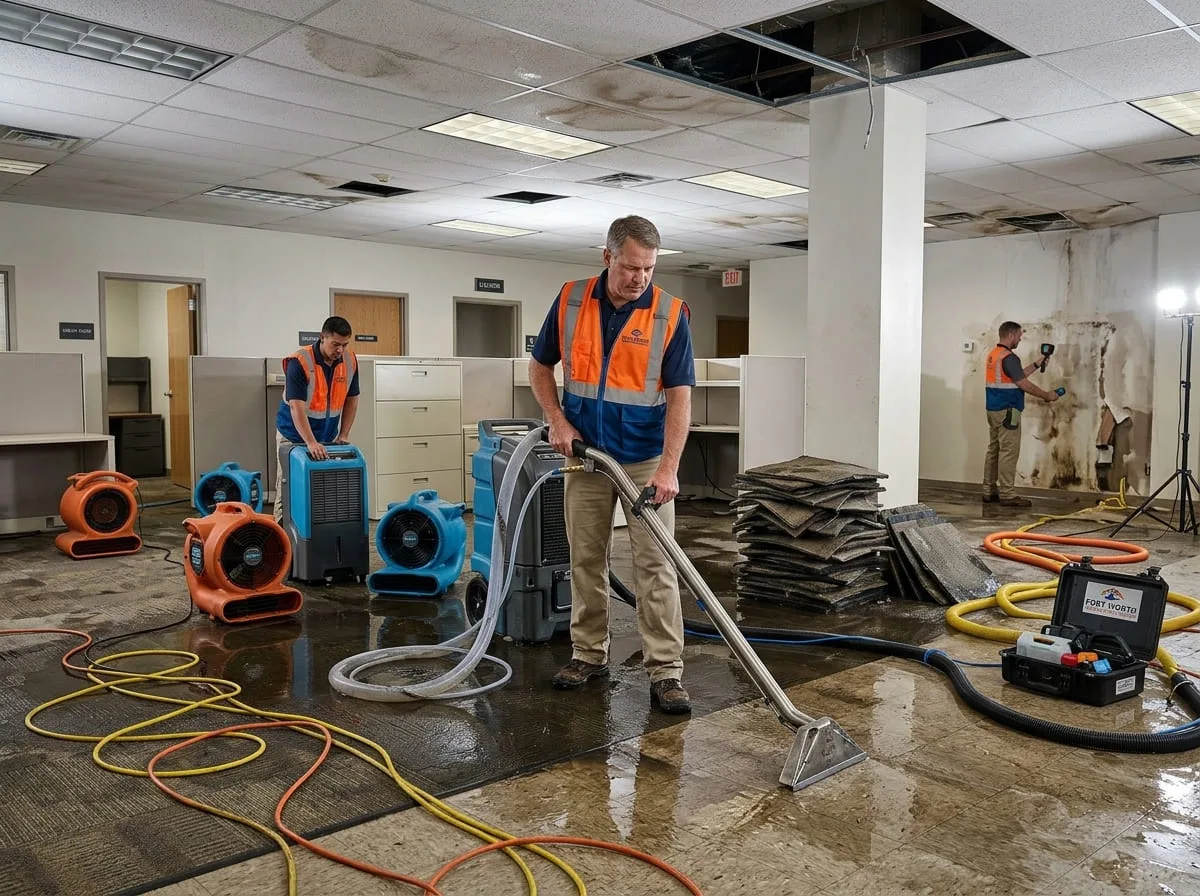
For an active leak or burst pipe, emergency water damage response starts with locating and stopping the source where that's within scope, followed by extraction of standing water with truck-mounted or portable equipment, moisture mapping to see how far water has traveled behind walls and under flooring, and setup of air movers and dehumidifiers to begin structural drying. A slab leak specifically often means water is traveling under flooring for longer than it looks like from the surface, so mapping matters more than it does with a visible pipe break.
For flood cleanup after a creek overflow or a heavy storm, the water is usually contaminated to some degree, which changes both the safety approach and the disposal decisions for affected materials — carpet, pad, and lower drywall that have been sitting in floodwater typically can't be salvaged, even when the same materials might be dried and saved after a clean-water pipe leak.
Sewage backups are treated as their own category regardless of cause, since contact with sewage-contaminated water carries health risks that require containment, proper protective equipment, and disposal of anything porous the water reached — not just extraction and drying.
Across all of these, structural drying is the step that determines whether a property actually recovers or ends up with a secondary mold problem weeks later. Monitoring moisture levels in framing, subfloor, and drywall until they're back to a normal range — not just until the surface looks dry — is what closes out a water loss properly.
Fire Damage Restoration in Haltom City
Older electrical systems are a real factor in a city where a meaningful share of homes date to the 1950s and 60s, and fire damage response in Haltom City covers everything from a contained kitchen fire to a loss serious enough to need emergency board-up and tarping to secure the property afterward.
The professionals handling fire damage calls also manage smoke and soot cleanup, odor removal, and contents cleaning, and coordinate fire damage repairs and reconstruction where that's part of the scope. Firefighting itself leaves a water damage problem behind in almost every structure fire — hundreds or thousands of gallons used to knock down flames need the same extraction and drying attention as any other water loss, and that overlap is part of why fire and water response are handled by the same restoration network rather than treated as separate problems.
Mold Remediation in Haltom City
Haltom City's long, humid North Texas summers mean any wet material that isn't dried quickly has a real head start toward mold growth, and that risk is highest after exactly the kind of events common here — a slab leak that went undetected for days, or a flooded room near Fossil Creek that isn't fully dried before the house gets closed back up.
Because the city is almost entirely slab-on-grade, mold concerns here typically show up at slab perimeters, inside wall cavities, and behind baseboards where a slow leak has kept a small area damp for an extended period, rather than in a crawl space or basement. Mold remediation addresses the growth itself along with the moisture source that caused it, since treating one without the other just invites the problem back.
Common Water Damage Scenarios Around Haltom City
A few situations show up again and again across Haltom City's neighborhoods, and most trace back to the city's age and geography rather than bad luck:
- Failures in original or aging galvanized steel supply lines inside homes built during the 1950s and 60s boom years, often surfacing as a slow wall leak before it becomes a sudden one
- Water heater failures in houses where the unit has never been replaced since original construction
- Slab leaks, where shifting Blackland Prairie clay soil stresses the plumbing running beneath a post-tension slab foundation and a leak develops with no visible source until flooring or baseboards start showing damage
- Flash flooding along Big Fossil Creek and Little Fossil Creek after intense spring and fall rainstorms, which has pushed water into homes near the creek corridors in documented past events
- Roof and ceiling leaks following North Texas hailstorms, which show up as water damage well after the storm itself has passed
- Supply line and connector failures at washing machines, dishwashers, and refrigerators in both single-family homes and the area's garden-style apartment communities
Residential and Commercial Water Damage in Haltom City
Most calls come from single-family homes in the dense, mid-century subdivisions that make up the bulk of Haltom City's housing stock, where the priority is usually stopping the source, pulling standing water, and getting air movers and dehumidifiers in place before drywall, flooring, and cabinetry take on more damage than necessary. Multi-family properties near the Fossil Creek area bring a different set of logistics — shared walls, stacked units, and the risk of one unit's leak affecting several others below or beside it — which calls for faster containment and coordination with property management.
Haltom City's commercial base still leans on the light-industrial and manufacturing footprint that built the city's economy, along with retail and warehouse space along US 377 and Beach Street. A burst overhead line or roof leak in a warehouse or plant floor threatens inventory, equipment, and downtime in a way a house doesn't, so commercial response is built around larger extraction equipment, industrial dehumidification, and getting a business back open as quickly as the drying process allows.
The Restoration Process and What to Do Next
A water damage call in Haltom City generally follows the same sequence regardless of whether the cause was a burst pipe or a creek flood: assess the damage and identify the source where possible, extract standing water, map moisture behind walls and under flooring, remove any materials that can't realistically be dried, set up air movers and dehumidifiers, and monitor drying progress until moisture readings return to normal — not just until surfaces look dry. Cleaning, sanitizing, and any repair work happen once the structure is confirmed dry, and not every material makes it through that process; a straightforward answer about what's salvageable is more useful than a promise that everything will be saved.
In the first few minutes after discovering water, shutting off the source at the fixture or main valve (if it can be reached safely), moving valuables out of standing water, and photographing the damage for insurance purposes all help — but the single biggest factor in the outcome is how quickly extraction and drying actually begin, which is why the call matters more than any of the prep steps around it.
Why Property Owners Call for Help Here
Work in Haltom City is carried out by trained restoration technicians using professional-grade extraction and drying equipment, with access to IICRC-certified expertise for the moisture mapping and structural drying that separates a fully dried property from one that looks dry on the surface. Every call is routed to insured, bonded restoration specialists equipped to respond around the clock, and insurance claim assistance — including documentation of the loss — is available through the professionals who handle the job.
Haltom City Water Damage FAQs
How fast can a water damage crew get to a home in Haltom City?
Calls are answered 24/7 and dispatched as quickly as crews, traffic, and weather allow. Because arrival time varies with conditions, the best move is to call the moment water is discovered rather than wait to see if it gets worse.
My house is near Little Fossil Creek and it flooded during a storm — what should I do first?
If it's safe to do so, avoid walking through standing floodwater, which can be contaminated and can hide electrical hazards, and shut off power to affected areas at the breaker panel only if it can be reached without stepping through water. Then call for emergency extraction as soon as possible — floodwater sitting in a home accelerates damage and mold risk by the hour.
Is a slab leak covered by homeowners insurance?
Coverage for slab leaks varies by policy and by what caused the leak, so it's worth reviewing the specific policy language or asking the insurer directly. Insurance claim assistance is available through the restoration professionals handling the job, including documentation that supports whatever claim is filed.
How do I know if my Haltom City home still has original galvanized supply lines?
Homes built during the 1950s and 60s boom were commonly plumbed with galvanized steel, which corrodes from the inside over decades and eventually fails. If the home hasn't had a repipe and the plumbing looks original, it's reasonable to treat any sudden leak or pressure drop as a possible sign of pipe failure and have it checked.
Do you handle both houses and commercial buildings in Haltom City?
Yes. Crews dispatched to Haltom City handle single-family homes, apartment and multi-family properties, and commercial and light-industrial buildings, with equipment scaled to the size of the loss.
What should I do before the restoration team arrives?
Shut off the water source at the fixture or main valve if it's safe to reach, move furniture and electronics out of standing water where possible, avoid contact with water near outlets or panels, and take photos of the damage for insurance purposes.
Nearby Service Areas
Water Damage in Haltom City Right Now?
Every hour water sits in a home or business adds to what has to be dried, cleaned, or replaced — get an emergency crew headed your way.
Need Help Now? Call (682) 610-3848