
Water Damage Restoration in Benbrook, TX
Benbrook homes are built on post-tension slab foundations with no basement to flood, but a supply line failure in one of the city's established mid-century sections, a hail-driven roof leak, or heavy rain overwhelming drainage near Benbrook Lake can all put water into a property just as fast.
Benbrook was incorporated in 1947, around the same time the U.S. Army Corps of Engineers began construction on Benbrook Dam just south of the city. The dam was completed in 1952, forming Benbrook Lake specifically for flood control after a string of damaging Trinity River floods in 1908, 1922, and 1936 convinced federal planners the watershed needed permanent flood-control infrastructure. That history is part of why Benbrook exists in its current form — the lake and the flood-control system built around it aren't an incidental feature of the city, they're a direct reason early development happened where it did.
The city sits in the southwest corner of Tarrant County, covers a little over 11 square miles, and had a population of roughly 24,500 as of the 2020 census, up from about 21,200 in 2010 and 20,200 in 2000 — a steady rather than explosive growth curve. Interstate 20 splits the city, and Fort Worth ISD serves Benbrook's public schools.
Housing stock reflects that growth pattern. Benbrook's established, central neighborhoods date largely to the postwar and mid-century building boom that shaped most of Tarrant County's inner-ring suburbs, meaning original galvanized steel supply lines are still in service in a real share of the city's older homes — the same well-documented failure point seen across the rest of the metro's mid-century housing stock. More recent growth has concentrated to the east along the Chisholm Trail Parkway corridor, where newer residential and commercial development is going in on copper and PEX supply lines with a different, generally lower, spontaneous-failure profile, though appliance, water heater, and connector-line failures still happen in a five-year-old home just as they do in a fifty-year-old one.
Like the rest of North Texas, Benbrook sits on expansive clay soils, which is why the city's homes — old and new alike — are built on post-tension slab foundations rather than basements. That's also why flash flooding, not slow-rise river flooding, is the pattern that actually threatens Benbrook properties: intense spring and fall thunderstorm systems dropping several inches of rain in a short window, overwhelming yard and street drainage before Benbrook Lake or the Trinity River system further downstream even factor in. Those same storm systems bring Tarrant County's well-documented hail risk — the region has seen some of the most damaging hailstorms in U.S. history, including events with softball-size hail in recent years — which drives a steady stream of roof-leak and wind-driven-rain water damage calls independent of any flooding at all.
Water Damage Restoration in Benbrook
Water damage restoration in Benbrook covers everything from first response on active flooding through the full extraction, drying, and cleanup process. Every call is routed to experienced restoration crews serving Benbrook and the wider southwest Tarrant County area, available around the clock for the situations that can't wait until morning: a burst supply line, an overflowing appliance, a sewage backup, or water intrusion after a storm.
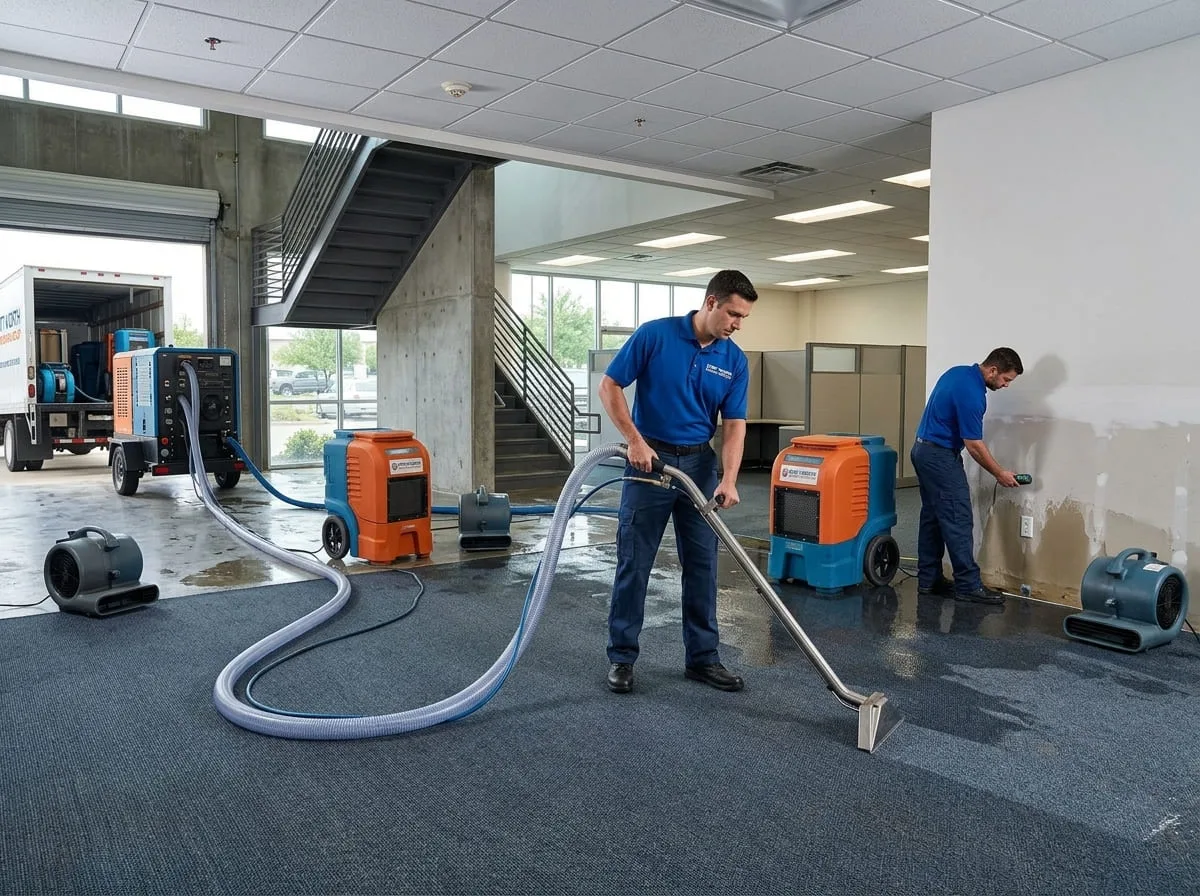
Emergency water damage restoration starts with stopping further intrusion where that falls within scope, then moving directly into water extraction and removal. Pumps and extraction equipment pull standing water out before it soaks further into flooring, baseboards, and drywall — the difference between materials that dry out and materials that have to be replaced usually comes down to how much time passed before extraction started.
Flood damage cleanup in Benbrook typically follows the same pattern seen across Tarrant County: fast-moving thunderstorm systems that drop heavy rain in a short window and overwhelm yard and street drainage, rather than a slow-rising river flood. Burst pipe water damage is a separate but common call, particularly in the city's older, established sections built during the postwar and mid-century boom, where original galvanized supply lines are more prone to corrosion and failure than the copper and PEX lines used in more recently built homes. Hard freeze events add another failure point for exposed or under-insulated lines regardless of a home's age. Sewage cleanup, when a backup does occur, is handled as its own category of contaminated-water response, with the containment and sanitation that kind of loss requires rather than treated like a standard cleanup.
Structural drying and dehumidification are treated as part of the same job as extraction, not an optional add-on. North Texas's long, humid stretches are a little more noticeable for properties close to Benbrook Lake, where evaporation off the water keeps ambient humidity slightly higher than drier inland areas, and that humidity slows natural drying and gives mold a better chance to take hold in materials that stay wet. Air movers and dehumidification equipment are placed to dry framing and wall cavities, not just the visible surface, with moisture levels checked over several days rather than assumed from a single visit.
A handful of patterns account for most of the water damage calls restoration professionals see in Benbrook: aging supply line failures in the established neighborhoods built out in the postwar decades; water heater, dishwasher, and washing machine connector failures, which show up in homes of any age; roof and attic leaks following the hail and wind that come through with North Texas's spring and fall storm systems; and slab-perimeter moisture tied to the region's expansive clay soils, which expand and contract enough over time to stress plumbing joints and slab edges. None of these are basement problems — Benbrook, like the rest of the Fort Worth metro, is built almost entirely on post-tension slab foundations, so water damage here means slab-level intrusion and wall or ceiling water tracking rather than a flooded lower level.
Residential water damage restoration in Benbrook covers everything from a single-room leak in an established resale home to a whole-house water event in one of the newer builds going up along the Chisholm Trail Parkway growth corridor on the city's east side. Commercial water damage restoration is available for the retail, office, and service properties along that same corridor and around the I-20 area, with equipment placement and drying schedules built around getting a business back open rather than treating a storefront the same way as an empty house overnight.
Fire Damage Restoration in Benbrook
Fire damage restoration is available for Benbrook homes and businesses on the same 24/7 basis as water damage response, from emergency board-up and roof tarping through smoke and soot cleanup, odor treatment, and full reconstruction. A fire doesn't stop causing damage once it's out — smoke travels through HVAC systems and wall cavities, soot etches into surfaces within hours, and the water used to fight the fire often causes a second wave of damage that needs its own extraction and drying response.
Restoration professionals responding to a Benbrook fire call are equipped to secure the property the same day, coordinate contents cleaning and pack-out for salvageable belongings, and carry the job through structural repairs under a general contractor licence — one point of contact from the night of the fire through the final walkthrough, rather than separate mitigation and reconstruction companies.
Mold Remediation in Benbrook
Mold in a Benbrook property almost always traces back to moisture that sat somewhere too long — a slow supply line leak behind a wall, a roof leak that went unnoticed through a storm, or slab-perimeter moisture that built up gradually along an exterior wall. Add in the higher ambient humidity that comes with being close to Benbrook Lake through the hotter months, and materials that stay wet even a couple of days longer than they should have a real chance of developing growth.
Mold remediation covers inspection, air and surface sampling, containment, removal of affected materials that can't be cleaned, and post-remediation verification once the work is finished. Because most residential mold traces back to a water event, the fastest path to resolving it is usually addressing the moisture source first, which is why water damage and mold calls in Benbrook are frequently handled by the same restoration professionals rather than two separate companies.
The Restoration Process for a Benbrook Property
The process generally follows the same sequence regardless of what caused the loss: an initial call and assessment, stopping the water source where that's within scope, extracting standing water, mapping moisture that's migrated into materials that look dry on the surface, removing anything that can't reasonably be dried, and running air movers and dehumidification equipment until moisture levels are back in a safe range. Not every material makes it through that process — carpet padding, saturated drywall, and wet insulation often need to come out rather than dry in place — and giving a straightforward answer about what has to go is part of doing the job honestly rather than promising an outcome no one can guarantee before an assessment happens. Insurance claim assistance is available through the restoration contractor handling the job, including documentation and direct communication with the assigned adjuster.
Licensed, Insured Restoration Partners Serving Benbrook
Every water damage call in Benbrook is routed to restoration crews who are licensed, insured, and IICRC-certified for water damage work. Certification of that kind means technicians are trained to a recognized standard for structural drying, moisture mapping, and water contamination categorization — not just running box fans and calling a room dry. The restoration partners handling these calls use professional-grade extraction and drying equipment and keep 24/7 dispatch available, so a Benbrook property owner isn't left waiting until Monday morning to get someone on-site for an active loss.
Benbrook Water Damage FAQs
Are Benbrook homes built with basements?
No. Like the rest of the Fort Worth metro, Benbrook sits on expansive clay soils, so homes here are built on post-tension slab foundations rather than basements. Water damage in a Benbrook home typically means slab-level intrusion, wall-cavity water tracking, or ceiling leaks rather than a flooded lower level.
Does living near Benbrook Lake increase flood risk for a home?
Benbrook Lake is managed by the U.S. Army Corps of Engineers specifically for flood control and is designed to hold significantly more water than its normal level during heavy rain, rather than releasing it into surrounding neighborhoods. The more common water risk for Benbrook properties, lakeside or not, is flash flooding from intense rainfall overwhelming yard and street drainage, or higher humidity near the lake slowing down drying after any water event.
What's the most common cause of burst pipe calls in Benbrook?
In the city's older, established neighborhoods built during the postwar and mid-century boom, original galvanized supply lines are a well-documented failure point as they age and corrode. In newer homes along growth areas like the Chisholm Trail Parkway corridor, copper and PEX lines are more failure-resistant but still vulnerable to freeze events, and appliance or connector-line failures happen in homes of any age.
How quickly should water be extracted from a Benbrook home?
As soon as possible. Materials that are extracted and drying within the first day or so are far more likely to be saved than materials left wet for several days, and Tarrant County's humid stretches shorten that window further by slowing natural drying and giving mold a better chance to establish itself.
Do restoration professionals serving Benbrook work with insurance companies?
Insurance claim assistance is available through the restoration contractor handling the job, including documentation of the loss and direct communication with the assigned adjuster. Coverage specifics still depend on the property owner's own policy, but the goal is to keep the paperwork from becoming a second job on top of the property damage.
What should I do before a restoration crew arrives at my Benbrook property?
Shut off the water source if it's safe to reach, avoid walking through standing water near outlets or a breaker panel, move valuables out of the affected area if it can be done safely, and photograph the damage for insurance purposes. Beyond that, it's best to wait for extraction equipment rather than attempting major cleanup without it.
Nearby Service Areas
Water Damage in Benbrook Doesn't Wait for Morning
Whether it's a burst line in an established neighborhood or storm water finding its way into a newer build near Chisholm Trail Parkway, the fastest path to a better outcome is getting extraction and drying started now.
Call Now for Water Damage Help