Water Damage Restoration in North Richland Hills, TX
Burst pipes, storm-driven roof leaks, and slab plumbing failures don't wait for business hours. Restoration crews serving North Richland Hills are dispatched 24 hours a day for emergency water extraction, structural drying, and full-service cleanup.
North Richland Hills incorporated in 1953, when the newly formed city held roughly 500 residents on the old Jones Farm. What followed was one of the fastest build-outs in Tarrant County: the population reached 8,662 by 1960, then more than doubled to over 16,500 by 1970, and nearly doubled again to over 30,500 by 1980. That 1960s-and-70s expansion is the reason a meaningful share of North Richland Hills housing sits on supply lines original to that era — galvanized steel plumbing that was standard at the time and is now well past the point where corrosion and reduced flow become a real failure risk, whether or not a given home has been repiped since.
Growth didn't stop there. The city kept adding residents through the 1980s, 90s and 2000s and now sits at roughly 70,000 people, making it one of the largest cities in Tarrant County. HomeTown NRH — a roughly 287-acre mixed-use neighborhood built around the city's central library near Davis Boulevard — is a newer-construction example running copper and PEX supply lines rather than the original galvanized runs found in the city's older sections. That mix, original 1960s-70s plumbing in some neighborhoods and newer PEX and copper in others, means the likely cause of a water call really does depend on which part of North Richland Hills it's coming from.
The Boulevard 26 (Texas 26) corridor is the city's long-running commercial spine. North Hills Mall opened there in 1979 and anchored the area for two decades before losing tenants to North East Mall across the highway; it closed in 2004 and was demolished a few years later, with North Richland Hills City Hall now standing on the site. The corridor around it is still one of the busier commercial strips in this part of Tarrant County, and it carries the same water damage exposure as any older retail and office corridor — aging roof membranes, flat-roof drainage that backs up in a hard rain, and mechanical rooms and slab plumbing that don't get much attention until something fails.
Foundations here are almost entirely slab-on-grade, consistent with the expansive clay soils across North Texas, so basement flooding isn't part of the picture — the water damage risk runs through roofs, walls, slab plumbing and appliances instead. Big Fossil Creek runs through the city on its way from Haltom City toward Richland Hills and the West Fork of the Trinity River, and low-lying property near any of the city's smaller drainage channels can see standing water fast in the kind of intense, short-duration storms typical of North Texas spring and fall weather. Hail is the other major driver: North Texas has one of the higher hail-frequency profiles in the country, and a damaged roof or window here turns into an interior water problem the same day if it isn't tarped.
Winters bring periodic hard freezes to North Texas, and exposed or poorly insulated supply lines and hose bibs anywhere in the city — older sections and newer construction alike — are at real risk of a freeze-and-burst failure during a multi-day cold snap. In the other direction, the long, humid North Richland Hills summer works against anyone drying out a wet building: the same humidity load that makes August feel heavy also slows evaporation from wet drywall, carpet pad and subfloor, which is exactly why fast extraction and mechanical dehumidification matter more here than they would in a drier climate.
Water Damage Restoration in North Richland Hills
A water loss doesn't wait for a convenient time, and the response doesn't either. Calls from North Richland Hills are routed to restoration crews prepared for emergency water damage restoration around the clock — arriving with extraction equipment, moisture meters and drying equipment ready to go to work, whether it's 2 p.m. on a Tuesday or 3 a.m. after a holiday storm.
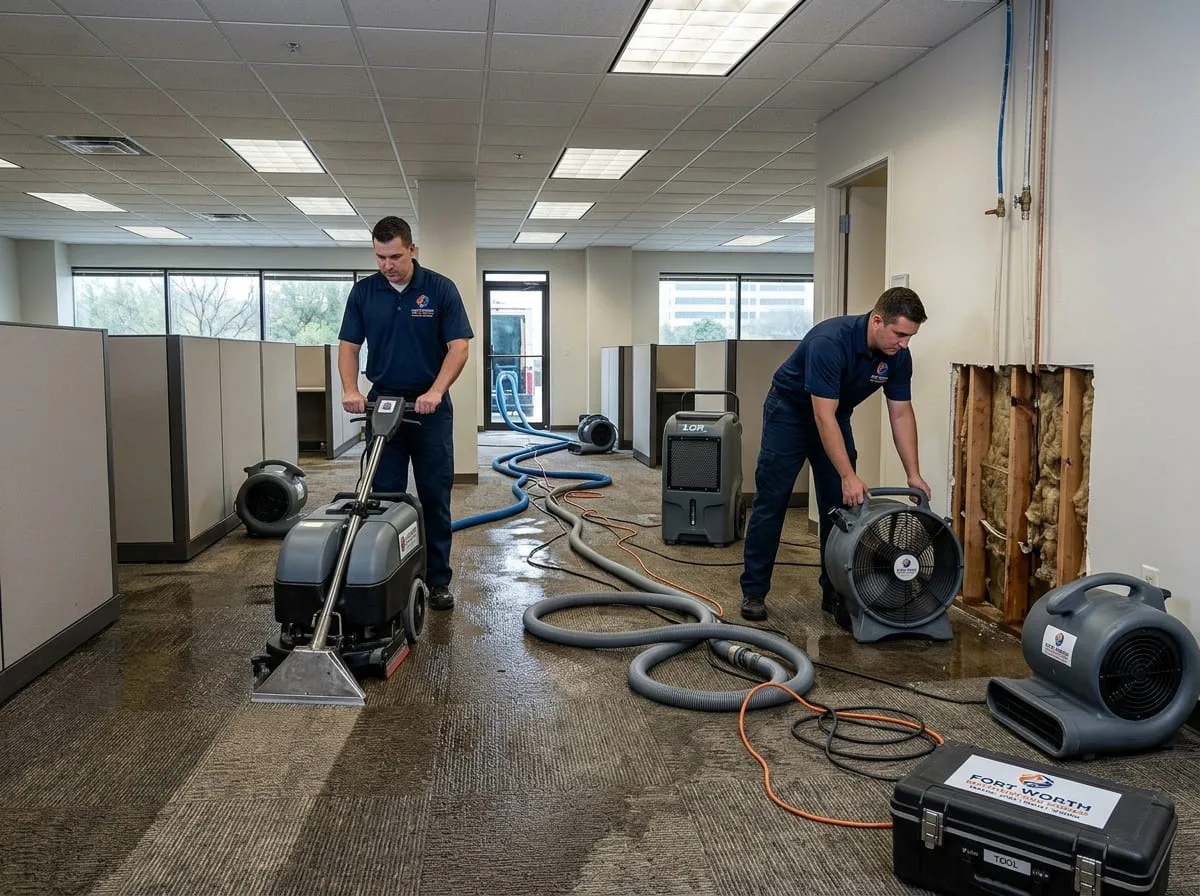
The first priority is getting standing water off floors and out of carpet pad through water extraction and removal, because every hour water sits is another hour it wicks further into flooring, baseboards and drywall. From there the work shifts to structural drying and dehumidification — industrial air movers and dehumidifiers positioned to pull moisture out of wall cavities and subfloor, not just the visible surface, with moisture readings tracked until the structure is actually back to a normal moisture content rather than just dry to the touch.
Burst pipe water damage is one of the most common calls in the older sections of North Richland Hills, where original galvanized supply lines from the city's 1960s and 70s building boom are well past their intended service life, and calls spike during winter freeze events when exposed lines split under pressure. Flood damage cleanup after a fast-moving spring or fall storm is the other recurring pattern, particularly for property near Big Fossil Creek or in low-lying spots where runoff has nowhere to go in a short, intense downpour.
Storm and rain water damage from wind-driven rain and hail-damaged roofing is a regular call across the city given North Texas's hail exposure, and it's handled alongside emergency board-up where a roof or window has failed and needs to be closed off before more water gets in. Sewage cleanup is also part of the response where a backup has contaminated the loss — that water is treated as its own category, with the containment and sanitation a contaminated-water loss requires, not handled the same as a clean supply-line leak.
Coverage runs across the full water damage restoration hub, with residential water damage restoration and commercial water damage restoration both scaled to the property they're actually treating rather than run off one template.
Fire Damage Restoration in North Richland Hills
Fire and water damage often arrive together — firefighting operations put a significant amount of water into a structure on top of whatever the fire itself damaged, and that suppression water needs the same fast extraction and drying attention as any other flood event, on top of smoke and soot cleanup.
Restoration partners handle the full scope, from emergency board-up and tarping that secures a property the same day, through smoke damage cleanup, soot removal, contents cleaning and pack-out, and fire damage repairs and reconstruction. Visit the fire damage restoration hub for the complete range of services available to North Richland Hills property owners.
Mold Remediation in North Richland Hills
North Richland Hills summers run long, hot and humid, which is exactly the combination that lets mold take hold in wet drywall, carpet pad and framing that isn't dried fast enough after a leak or flood — often within 24 to 48 hours in the wrong conditions. That's the direct link between the water damage calls above and the mold calls that follow them.
Mold after water damage is the most common mold scenario in this market by far, and it's treated as a continuation of the original water loss rather than a separate problem: find the moisture source, dry the structure properly the first time, and remediate any growth that already started before drying began. Where growth is more established, black mold remediation and residential or commercial mold remediation are handled with proper containment — without the fear-based claims some companies lean on. Mold inspection, testing and post-remediation clearance verification round out the full scope.
Common Water Damage Scenarios in North Richland Hills
A handful of patterns show up again and again across the city's housing stock and commercial corridors:
- Galvanized supply line failures in homes built during the 1960s-70s boom, often behind walls or under the slab, showing up as a sudden pressure drop or a wet spot on flooring before anyone finds the actual leak
- Freeze-related pipe bursts at exposed hose bibs, garage plumbing and poorly insulated lines during multi-day winter cold snaps
- Hail and wind damage to roofing along the Boulevard 26 corridor and residential neighborhoods alike, letting rain into attics and ceilings during the next storm system
- Water heater and appliance connector-line failures in both older and newer homes — a failure mode that isn't tied to a home's age the way supply-line corrosion is
- Slow slab leaks that raise a water bill before they raise any other flag, common enough across North Texas's post-tension slab construction to be worth checking for early
- Flash-flood-style ponding near Big Fossil Creek and other low-lying drainage areas after short, intense storms
Residential and Commercial Water Damage Restoration
North Richland Hills is a mix of single-family neighborhoods, apartment and multifamily communities, and a real commercial base along Boulevard 26 and Davis Boulevard. Residential water damage restoration covers everything from a single-story home built during the city's mid-century boom to a two-story build in a newer subdivision or a HomeTown townhome, with the drying plan built around that structure's actual materials and layout rather than a generic template.
Commercial water damage restoration is handled with the added pressure that comes with keeping a business running — retail space, medical and professional offices, restaurants, and the office and light-industrial space along the city's highway corridors all need extraction and drying that accounts for inventory, equipment and the cost of downtime, not just the building itself.
What Happens After You Call
The process starts with a call and a damage assessment — what's flooded, what the source is, and whether it's still active. Where the source is within the crew's scope to address, stopping it comes first.
From there: water extraction to remove standing water, moisture inspection and mapping to find out how far the water actually traveled (often further than it looks), removal of any materials that can't reasonably be dried and saved, and industrial air movers and dehumidifiers set up to dry what's left. Drying progress is tracked with moisture readings rather than guesswork, and cleaning, sanitizing and documentation happen as the loss requires. Not every material survives a water loss — a straightforward answer about what's salvageable and what isn't is part of the job, not an afterthought.
Licensed, Insured Restoration Partners
Every emergency call from North Richland Hills is routed to restoration professionals who are licensed, insured and equipped for water, fire and mold work across Tarrant County. Access to IICRC-certified expertise means technicians follow recognized standards for moisture measurement, structural drying and contamination categories rather than working from guesswork.
Insurance claim assistance is available through the restoration partner handling the job, and documentation — photos, moisture readings, a clear scope of work — is kept as a standard part of the process, specifically because insurance carriers require it.
North Richland Hills Water Damage FAQs
How fast can water extraction start in North Richland Hills?
Calls are routed to restoration crews prepared for 24/7 dispatch, and extraction typically begins the same visit once a technician is on site — the priority is getting standing water off floors and out of carpet before it spreads further into the structure.
Does North Richland Hills flood, or is this mostly a storm and roof-leak market?
Both. Basement flooding isn't a factor since the city is built on slab-on-grade foundations, but low-lying areas near Big Fossil Creek and other drainage channels can pond quickly in a fast-moving storm, and hail and wind-driven rain regularly get into roofs and attics across the city.
My house is from the 1960s or 70s — is my plumbing part of the problem?
It can be. A meaningful share of housing from North Richland Hills' 1960s-70s building boom is still on original galvanized steel supply lines, which corrode from the inside over decades and are a well-documented failure point in homes of that era across North Texas, whether or not a specific home has already had issues.
Can wet drywall be dried, or does it need to be cut out?
It depends on how long it's been wet and what's behind it. Drywall that's caught early and dried properly with air movers and dehumidification can often be saved; drywall that's been wet more than about 24-48 hours, especially with swelling or contamination, more often needs to come out.
Should I turn off electricity after a flood or leak?
If water is anywhere near outlets, switches or fixtures, shut off power to that area at the breaker if you can do so safely without stepping into standing water. If reaching the breaker means walking through water, leave it alone and wait for a professional rather than risking shock.
Do you work with insurance companies?
Yes — insurance claim assistance is available through the restoration partner handling the job, including the documentation most carriers require: photos, moisture readings and a written scope of work.
What should I do before the restoration team arrives?
Stop the water source if it's safe and accessible, move valuables and electronics out of the affected area, and avoid walking through standing water if there's any chance it's near an electrical source or contaminated by sewage.
Do you serve all of North Richland Hills, including HomeTown and the area near NRH2O?
Yes — calls from every part of North Richland Hills are routed to restoration crews serving the full city, from older neighborhoods near Boulevard 26 to newer construction around HomeTown and the areas near NRH2O.
Nearby Service Areas
Water Damage in North Richland Hills Doesn't Wait — Neither Should You
Every hour water sits is an hour it spreads further into flooring, drywall and framing — get connected with a restoration crew ready to respond now.
Need Help Now? Call (682) 610-3848