
Watauga Water Damage Restoration
Watauga's homes sit close together across just over four square miles, so water from a burst pipe or a stalled storm rarely stays contained to one house. Extraction and drying crews are dispatched around the clock.
Watauga is a small city by design as much as by history. At 4.16 square miles with a population in the low twenty-thousands, it's one of the more densely populated suburbs in northeast Tarrant County — a legacy of how fast it grew rather than how it was originally settled. The town traces back to a post-Civil War settlement named for Cherokee villages in Tennessee, and it stayed genuinely small for decades: a station went in when the Texas and Pacific Railway came through in 1881, a post office opened in 1883, and the population was still only around 65 residents into the mid-1930s.
That changed after World War II, when nearby defense plant development pulled Watauga into the region's suburban growth wave. The numbers tell the story: roughly 1,000 residents by the mid-1960s, over 7,000 by 1976, and past 20,000 by 1990. Almost the entire city was built out inside about a fifteen-year stretch from the mid-1960s through the mid-1970s — a narrower, more concentrated construction window than many surrounding suburbs saw. That matters for water damage for one specific reason: a large share of Watauga's original supply lines are the same age, which means galvanized steel plumbing that has been corroding and narrowing from the inside for fifty-plus years shows up across the whole city rather than in a few scattered older blocks.
Like the rest of North Texas, Watauga sits on expansive clay soil, which is why the city is built almost entirely on slab foundations rather than basements. There's no flooded-basement scenario here — water damage shows up coming down from a roof or ceiling, in through a door or window during a heavy storm, or up from a plumbing failure at or below the slab. Watauga is completely surrounded by Keller, Fort Worth, Haltom City, and North Richland Hills, with US Highway 377 running through as the main commercial corridor, which is where most of the retail and small business space needing water damage response is concentrated.
Water Damage Restoration in Watauga, TX
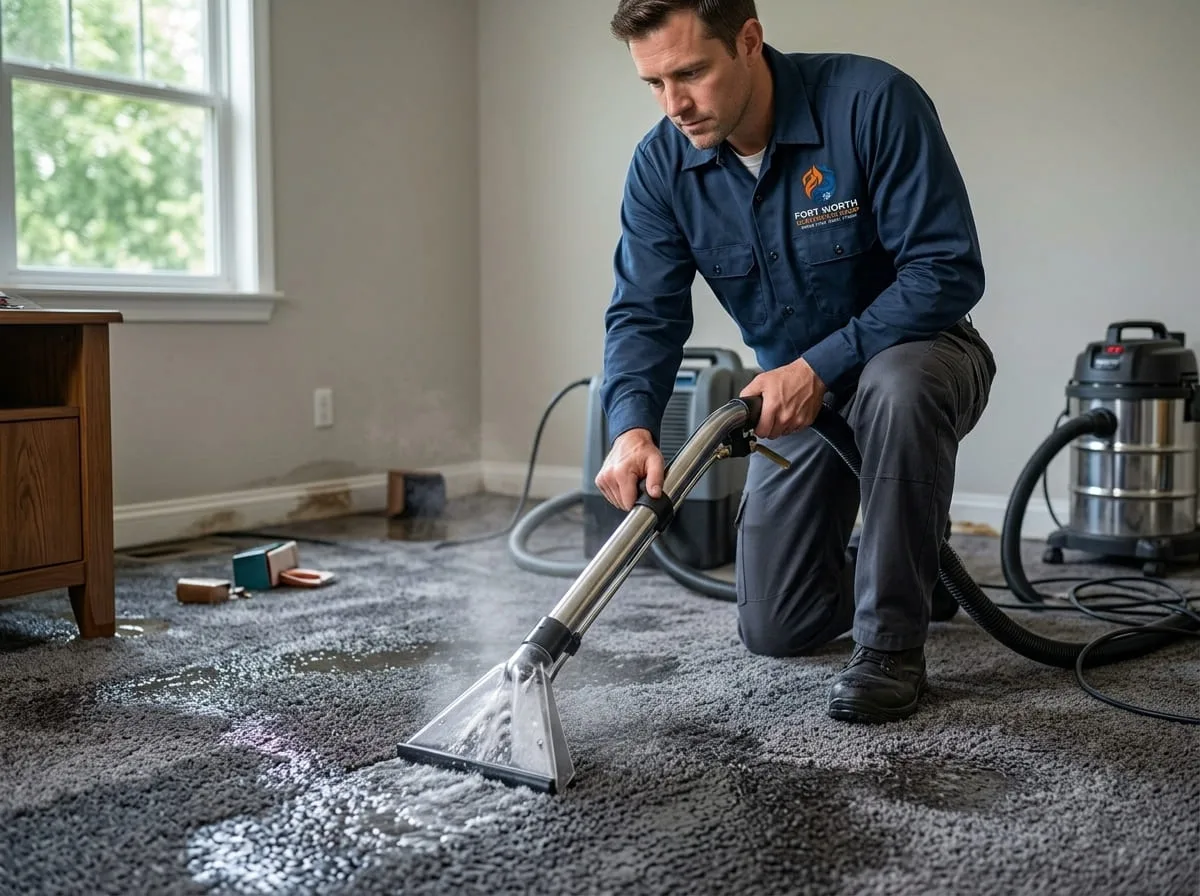
When water shows up somewhere it shouldn't — a bathroom overflow spreading into a hallway, a supply line letting go behind a kitchen cabinet, a flat commercial roof taking on standing water during a spring storm — the first hour matters more than almost anything that happens afterward. Emergency water damage restoration starts with stopping the water at its source where that falls within scope, then moves straight into extraction: pulling standing water out of carpet, flooring, and low areas with extraction equipment before it wicks further into walls, baseboards, and subfloor.
Extraction only deals with the water that's visible. What's already absorbed into drywall, insulation, and framing has to be tracked with moisture meters and dried using air movers and dehumidifiers, with readings checked over the following days until materials are back to a safe moisture level. Rushing or skipping this step is the single biggest reason a water loss turns into a mold problem two weeks later instead of a closed job.
Burst and failing supply lines are a routine call in Watauga specifically, for reasons tied to the city's construction era — covered in more detail below. Structural drying and moisture control after a leak are directly connected to whether mold prevention efforts succeed, which is why extraction, drying, and moisture monitoring get treated as one continuous job instead of separate steps.
Flood damage cleanup after a heavy rain event follows a similar path but usually involves more contaminated water across a wider area — water that came in through a door threshold, a window well, or a roof failure carries dirt and debris with it, which changes both the safety precautions taken and the materials that can realistically be saved.
Sewage cleanup is handled as its own category because contaminated water requires different protective equipment and disposal procedures. Carpet padding, drywall paper facing, and other porous materials that absorb sewage-contaminated water typically can't be cleaned and dried the way a clean water loss can — they have to come out.
Fire Damage Restoration in Watauga, TX
Fire damage restoration in Watauga starts wherever the fire department leaves off — emergency board-up and tarping to secure the structure, followed by smoke and soot cleanup, contents cleaning and pack-out for anything salvageable, and repairs or reconstruction where needed. Because Watauga's lots and homes sit close together, a fire in one house often means smoke exposure or firefighting water reaching a neighboring property even without direct flame contact, and that secondary damage needs its own assessment.
Water used to fight a fire doesn't disappear once the flames are out. Firefighting water damage cleanup is its own service for exactly that reason — the water applied to a structure fire needs extraction and drying just like any other water loss, on a timeline that matters just as much because it's happening on top of an already damaged building.
Mold Remediation in Watauga, TX
Mold needs moisture, a food source, and time — and Watauga's climate supplies the first ingredient generously. Long, humid North Texas summers speed up mold development in any wall cavity or ceiling that stayed wet longer than it should have, whether the source was a slow slab leak nobody noticed for weeks or a burst pipe that got a fast response but not a thorough enough drying job.
Because Watauga is built on slab foundations rather than basements, mold risk here tends to show up at slab perimeters, behind baseboards, and inside wall cavities fed by a hidden plumbing leak, rather than in a below-grade space. Mold after water damage is the most common path into a remediation job — a water loss that wasn't fully dried within the first couple of days is the single biggest predictor of a mold call a few weeks later.
Common Water Damage Scenarios in Watauga
Certain causes come up more often in Watauga than in a newer-built suburb, mostly tied to when and how densely the city was constructed:
- Failing galvanized supply lines in homes built during Watauga's mid-1960s-to-mid-1970s growth boom, when most of the city's housing went up in a single concentrated stretch
- Slab leaks from hot and cold water lines routed through the foundation, harder to catch early since there's no exposed pipe run or crawl space to check
- Water heater failures in units original or close to original age, common in homes now in their fifth decade
- Roof and ceiling leaks following hail and wind events, which this part of Tarrant County has seen at damaging scale more than once in recent decades
- Storm water intrusion during heavy spring and fall rain, worse on tightly spaced lots where a neighboring yard's runoff has fewer places to go
- Washing machine and dishwasher supply line failures in older kitchens and laundry closets that haven't been updated since original construction
Residential and Commercial Water Damage Restoration
Watauga is overwhelmingly residential — single-family homes on small, closely spaced lots make up most of the city inside its 4.16 square miles — and residential water damage restoration covers everything from a single flooded bedroom to a whole-house loss after an extended supply line failure. The duplexes and multifamily buildings scattered through the city add a wrinkle of their own: a leak on one side of a shared wall or an upper unit often means water reaching a neighboring unit before anyone downstairs notices.
The retail and small business space along US Highway 377, Watauga's main commercial corridor, needs a different approach. Commercial water damage restoration accounts for slab construction, larger open floor plans, and the priority most business owners have of reopening quickly — which often means drying equipment runs after hours or work is phased around business operations rather than closing a location down completely.
The Restoration Process
No two water losses in Watauga look identical, but the response generally follows the same sequence. Not everything survives it — heavily soaked insulation, swollen particleboard cabinetry, and flooring wet for more than a day or two often have to be replaced rather than dried in place.
- Initial call and damage assessment
- Stopping the water source where within scope
- Water extraction from floors, carpet, and standing areas
- Moisture mapping to trace water behind walls and under flooring
- Removal of materials that can't be dried in place
- Air movers and dehumidifiers for structural drying
- Drying verification with moisture readings before repairs begin
Licensed Professionals, Ready Around the Clock
Every call from Watauga is routed to restoration professionals who are licensed, insured, and equipped for 24/7 emergency response, the same standard applied across the rest of the service area. IICRC-certified training is what separates a straightforward extraction-and-dry job from one that leaves hidden moisture behind a wall to become a mold problem later, and it's the standard the restoration partners handling these calls are held to.
Insurance claim assistance is available through the restoration contractor taking on the job, including the kind of documentation — photos, moisture readings, and a clear scope of work — that insurance carriers typically ask for during a water damage claim.
Watauga Water Damage FAQs
How quickly can someone respond to water damage in Watauga?
Restoration crews serving Watauga are set up for 24/7 dispatch, since water damage doesn't wait for business hours. Emergency calls involving active water are prioritized, but the exact timeline for any single call depends on current conditions and call volume — nobody can honestly promise an arrival time before assessing the situation.
Are older Watauga homes more likely to have a pipe burst?
Yes, generally. A large share of Watauga's housing was built during the mid-1960s through mid-1970s boom that took the city's population from roughly 1,000 to over 20,000 in about 25 years. Homes from that era commonly still have original or aging galvanized steel supply lines, which corrode and narrow internally over decades — a well-documented failure point in North Texas homes of that age.
Does Watauga have basements that can flood?
No. Like the rest of North Texas, Watauga is built on slab foundations because of the region's expansive clay soil, so there's no basement flooding scenario here. Water damage instead shows up through roof and ceiling leaks, window and door intrusion during storms, or plumbing failures at or below the slab.
Can wet drywall be saved after a water leak?
Often, yes, if the water was relatively clean and the drywall is dried quickly with the right equipment. Drywall that's been wet for an extended period, or that's swelling, bubbling, or crumbling, usually needs to be cut out and replaced instead.
Do you work with insurance companies on water damage claims in Watauga?
Insurance claim assistance is available through the restoration contractor handling the job, including documentation like photos, moisture readings, and a written scope of work that most carriers ask for during a water damage claim.
What should I do before restoration crews arrive?
Shut off the water at the source if it's safe to do so, avoid electrical outlets or switches near standing water, move belongings away from the wet area, and photograph the damage before cleanup starts. Leave wall or ceiling cavities alone rather than opening them up without guidance.
Nearby Service Areas
Water Damage in Watauga Doesn't Wait
The sooner extraction and drying start, the more of your home or business is likely to be saved — day or night.
Need Help Now? Call (682) 610-3848