
Water Damage Restoration in Saginaw, TX
From a corroded supply line in an Old Town Saginaw house to a slab leak in a subdivision that didn't exist ten years ago, water damage in Saginaw gets a 24/7 emergency response — every call is routed to restoration crews equipped to reach the city's older core and its newest neighborhoods alike.
Saginaw's identity is tied to rail and grain. The area was a farming settlement called Dido before the Civil War, renamed Saginaw in 1882 after a Michigan town once three rail lines — the Chicago, Rock Island and Gulf; the Gulf, Colorado and Santa Fe; and the Fort Worth and Denver City — converged here in the 1880s. The Burrus Mill and Elevator Company arrived in 1936 and built what was then the largest grain elevator in Texas. The elevators and the BNSF and Union Pacific lines still running through town are why locals still describe Saginaw as a 'train and grain' city, even as it's grown into something much bigger.
The growth is the other half of the story. Saginaw held under a thousand residents through the 1950s, then climbed to roughly 8,550 by 1990, about 12,400 by 2000, and near 24,000 at the 2020 census — with the city projecting continued growth toward 35,000 as it approaches full build-out. That trajectory shows up on the ground as a real split in the housing stock: an established core clustered around the historic downtown and the grain elevators, generally dating to the 1970s through the 1990s in neighborhoods like Whisperwood Estates and Saginaw Ranch, alongside newer construction that has continued well into the 2020s in communities like Willow Creek Estates, Highland Station near the I-35W corridor, the master-planned Marine Creek Ranch, and the Beltmill mixed-use development.
That age range matters for how water damage actually shows up. North Texas is a slab-on-grade market almost everywhere, and Saginaw is no exception even in its oldest sections — the region's expansive clay soils make basements impractical, so there's no flooded-basement scenario to plan for here. What changes with the age of a house is what's running behind the walls. Homes from the 1970s through the early 1990s are more likely to still be on original or aging galvanized steel or early copper supply lines, a material that corrodes and pinholes from the inside with no visible warning before it fails. Construction from the late 1990s onward is far more commonly on PEX or newer copper, which carries a lower spontaneous-failure risk but is still exposed to water heater, ice maker, and washing machine connector failures — the appliance-driven leaks that show up regardless of a home's age.
Weather adds another layer. Saginaw sits inside the same North Texas hail corridor that produced the 1995 Mayfest hailstorm and the April 2023 hail event that brought baseball- and softball-size stones through parts of Tarrant County — the kind of storm that opens up a roof or damages flashing well before anyone notices a leak starting. Spring and fall frontal systems also bring the flash-flood pattern typical of North Texas creeks rather than slow-rise river flooding: Marine Creek, whose reservoir borders Saginaw's southwest edge near the Marine Creek Ranch community, and Big Fossil Creek to the east, both move heavy rainfall through low-lying yards, driveways and roadways quickly after an intense storm.
One practical note specific to Saginaw: it runs its own water and wastewater utility, separate from the City of Fort Worth system next door. A suspected water main break or sewer backup at the street should go to Saginaw's own public works and utility billing office, not a Fort Worth line — that's a different call from the one made to get standing water out of a house, but it matters for getting the source of the problem addressed.
Water Damage Restoration in Saginaw
Whatever the source — a failed supply line in an Old Town Saginaw house, a slab leak under a newer build near Beltmill, or a backed-up sewer line after a heavy spring storm — the first hours decide how much of a home or business can actually be saved. Extraction and drying take priority the moment a call comes in, ahead of any conversation about repairs or reconstruction.
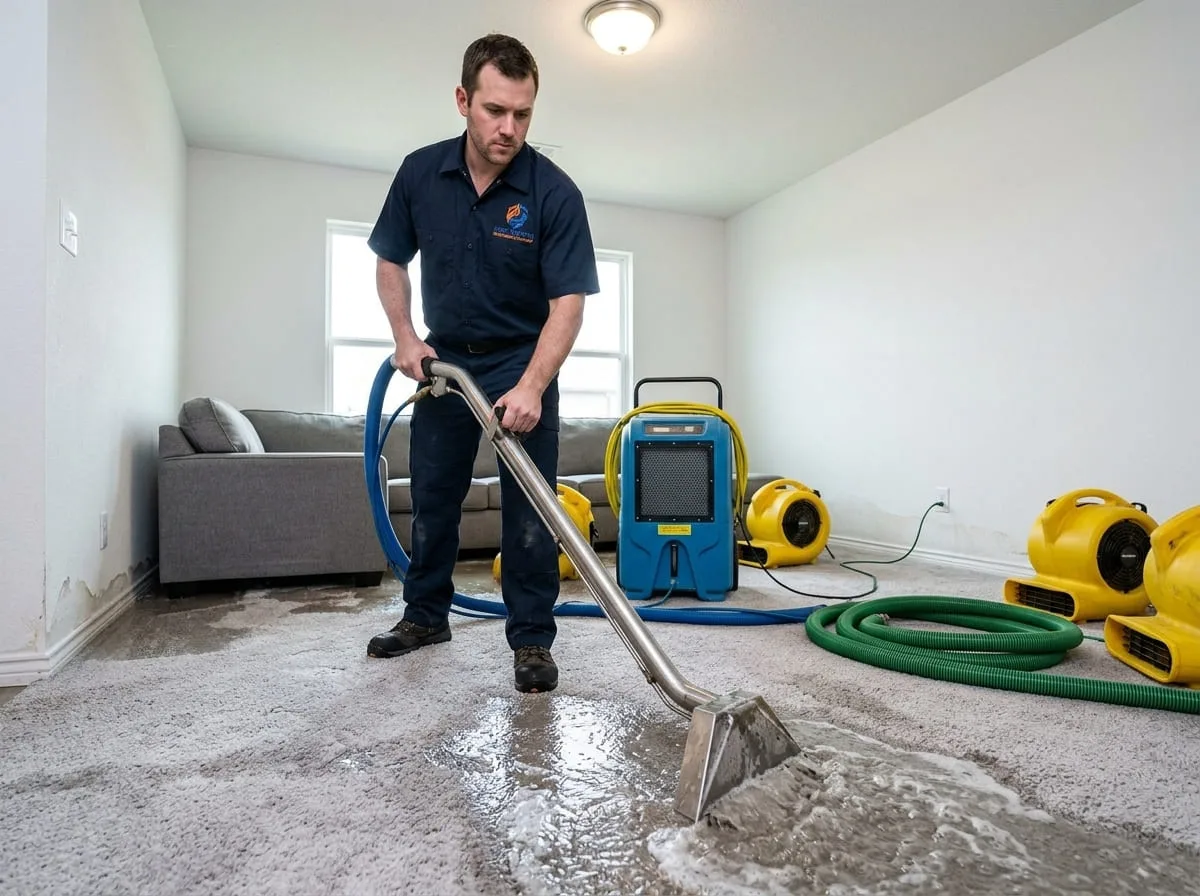
Emergency water damage restoration in Saginaw covers the range of losses the city actually produces: standing water removed with truck-mounted or portable extraction equipment, flood cleanup after a storm overwhelms drainage near Marine Creek or Big Fossil Creek, burst pipe water damage from a corroded supply line letting go inside a wall or slab, and sewage cleanup when a backed-up lateral sends contaminated water into a house — a job that calls for containment, proper disposal and disinfection, not a wet-vac and good intentions.
Once standing water is gone, structural drying and dehumidification is what actually prevents the more expensive second problem. Air movers and commercial dehumidifiers are set and monitored against moisture readings taken inside wall cavities, under flooring and in subfloor space — not against a guess about how long a room 'should' take. North Texas summers add real humidity to that equation, and the tighter, better-insulated construction found in Saginaw's newer subdivisions can trap moisture just as easily as an older, leakier house if drying isn't tracked properly.
Fire Damage Restoration in Saginaw
Fire damage in Saginaw brings its own urgency, from a kitchen fire in an established Old Town home to a larger loss in one of the city's newer subdivisions or commercial spaces. The professionals taking these calls handle emergency board-up and tarping to secure a property immediately after a fire, followed by smoke and soot cleanup, odor removal and, where the loss involved a fire crew's response, firefighting water damage cleanup — the extraction and drying work needed once the water used to put a fire out becomes its own problem.
Contents cleaning and pack-out protects what's salvageable while repairs happen, and fire damage repairs and reconstruction return the property to a livable or usable condition once the restoration side of the work is complete. See the fire damage restoration hub for the full scope of what's covered.
Mold Remediation in Saginaw
Mold risk in Saginaw is almost always a moisture problem first. North Texas summers bring long stretches of high humidity, and a slab-on-grade home that's had a leak or slow moisture intrusion — along a slab perimeter, inside an exterior wall cavity, or around a poorly flashed window or roof penetration — has the conditions mold needs within days, not weeks, if it isn't dried properly. This is true whether the house is in Saginaw's original core or one of its newest subdivisions; construction age changes the source of the moisture, not the outcome once it's there.
Mold after water damage is the highest-priority mold scenario for exactly this reason — it's a water problem that's been left too long, not a separate issue. Where the growth is concentrated around slab perimeters or wall cavities rather than a true crawl space, crawl space and slab moisture mold remediation addresses that specific pattern. Testing, containment and remediation are handled without inflated health claims or invented methodology — a straightforward explanation of what's found and what it takes to remove it.
Common Water Damage Scenarios in Saginaw
A few patterns come up again and again across Saginaw's mix of housing ages and building types:
- Pinhole leaks and full pipe failures in aging galvanized or early copper supply lines in homes built through the early 1990s, often discovered as a slow ceiling stain or a spike in the water bill before anyone sees water
- Slab leaks under post-tension foundations, common across every era of North Texas construction, showing up as warm spots on flooring, unexplained water usage, or a persistently damp patch near a wall
- Roof and attic leaks following hail and wind events, where damage isn't obvious until a stain appears on a ceiling days or weeks after the storm that actually caused it
- Washing machine, ice maker, dishwasher and water heater connector failures — largely age-independent and common in both Old Town Saginaw homes and the newest builds near Highland Station or Marine Creek Ranch
- Sewer lateral backups in the older sections of the city, where clay or aging cast-iron lateral lines are more prone to root intrusion and blockage than the PVC lines used in newer subdivisions
- Flash-flood intrusion around low-lying yards and driveways near the Marine Creek and Big Fossil Creek drainage after intense spring and fall storms
Residential and Commercial Water Damage Capability
On the residential side, that means everything from a single burst line in an established Whisperwood Estates or Saginaw Ranch home to a multi-room loss across a newer Willow Creek Estates or Marine Creek Ranch property, each handled at the scale the damage actually calls for.
Saginaw's commercial base runs deeper than its residential growth suggests — the industrial corridor behind the grain elevators still includes rail-served freight and warehousing operations, alongside the retail, restaurant and office space arriving with newer mixed-use projects like Beltmill and The Prose Saginaw apartments. Commercial water losses bring their own scale problems: large open floor plans, sprinkler system discharges, rooftop HVAC and drainage failures on flat commercial roofs, and the operational pressure of getting a business back open. Commercial water damage restoration is built around minimizing that downtime as much as around the physical drying itself.
The Restoration Process, Start to Finish
The sequence generally runs the same way regardless of which part of Saginaw the call comes from: the initial call and damage assessment, identifying and stopping the water source where that falls within scope, extraction of standing water, moisture inspection and mapping behind walls and under flooring, removal of materials that genuinely can't be dried and saved, air movement and dehumidification monitored against real moisture readings, and cleaning and sanitizing affected areas. Not every loss follows the exact same path, and not every material can be saved — a straight answer about what's salvageable and what isn't is part of the job, not an afterthought.
Who Actually Does the Work
Every call from a Saginaw address is routed to restoration professionals who are licensed, insured and IICRC-trained for water damage work — credentials that mean the technicians on-site have been trained to a recognized industry standard for extraction, drying and moisture measurement, not just handed a wet-vac and a truck. Restoration partners follow recognized industry standards for documenting a loss, which also supports a homeowner's insurance claim rather than working against it.
Saginaw Water Damage FAQs
How fast does water need to come out of a Saginaw home?
As fast as it can be safely extracted. On a post-tension slab, water spreads under flooring quickly, and drywall, baseboards and cabinetry begin absorbing moisture within hours. Waiting overnight substantially raises the odds that flooring and drywall have to be replaced rather than dried in place.
Are older Saginaw homes more likely to have galvanized pipes?
Homes built through the 1970s, 80s and early 90s — common in Saginaw's original core and neighborhoods like Whisperwood Estates and Saginaw Ranch — are more likely to still have original galvanized or early copper supply lines, which corrode from the inside and can fail without warning. Newer construction is generally on PEX or updated copper, which carries a different, generally lower, failure profile.
Do newer Saginaw subdivisions still get water damage?
Yes. Newer homes in areas like Highland Station, Willow Creek Estates and Marine Creek Ranch are less prone to spontaneous pipe failure, but slab leaks, appliance connector failures, water heater ruptures and roof leaks after hail don't care how new a house is.
Should the electricity be turned off after flooding?
If water has reached outlets, wiring or an electrical panel, or if there's any doubt about safety, don't enter the area and don't touch switches or panels — call a licensed electrician or the utility provider first. Restoration crews are trained to assess electrical hazards before extraction begins in an affected area.
Can carpet and drywall be saved after a leak?
It depends on the water source and how long it sat. Clean water addressed quickly can often be extracted and dried in place. Water that's contaminated, that sat for more than about 24 to 48 hours, or that's soaked into drywall or padding usually means those materials need to come out rather than be dried — a moisture assessment on-site determines which applies.
Do restoration crews serving Saginaw work with insurance companies?
Insurance claim assistance is available through the restoration contractor handling the work, including the kind of documentation — photos, moisture readings, a clear scope of work — that supports a claim rather than complicating it.
Who do I call for a water main break versus water inside my house?
Saginaw operates its own water and wastewater utility separate from Fort Worth's system, so a suspected main break or issue at the street should go to the City of Saginaw's public works department. Water already inside a home or business is a separate call to a restoration team, and both calls can happen at the same time.
Does mold show up quickly after water damage in Saginaw?
It can, especially during the region's long, humid summer stretches. Visible growth is possible within a matter of days on wet drywall, wood or insulation that isn't dried properly, which is why fast extraction and monitored drying matter as much for mold prevention as for the water damage itself.
Nearby Service Areas
Water Damage in Saginaw Doesn't Wait — Neither Should the Call
Whether it's a slab leak in a new build near Beltmill or a supply line failure in an Old Town Saginaw home, the restoration crews taking these calls are ready to respond 24 hours a day, every day of the year.
Need Help Now? Call (682) 610-3848