Water Damage After Firefighting
Fighting a fire can leave a structure holding more water damage than fire damage — here's why the water response can't wait.
Last updated 2026-09
Most people picture fire damage as burned framing, blackened walls, and smoke residue. What often gets less attention until it's too late is the water. A single hose line can flow well over a hundred gallons a minute, and a working structure fire is rarely fought with just one. By the time the fire is out, a property can be holding more water damage than fire damage — soaked carpet, saturated drywall, standing water on multiple floors, and moisture that traveled into rooms the fire never touched.
This is the point in a fire loss where the clock starts on a second, separate problem. Fire damage stops getting worse the moment the fire is extinguished. Water damage keeps getting worse for every hour it isn't addressed. That's why the response immediately after firefighters leave the scene matters as much as the fire cleanup itself.
This article covers why suppression water causes damage on its own, why it needs a fast and specific response, and where to go for the full extraction and drying process this overlaps with.
Why Extinguishing the Fire Creates a Water Damage Event
Fire hoses and sprinkler systems are built to deliver a lot of water quickly, because that's what puts a fire out. That same volume has to go somewhere once the fire is under control, and most of it soaks into the building rather than draining away. Carpet, padding, subfloor, drywall, and insulation all absorb water readily, and a fire fought from multiple hose lines or over an extended period can leave a structure more waterlogged than a typical burst-pipe flood.
Sprinkler activation in a commercial building follows the same pattern at a larger scale. A single sprinkler head can discharge for several minutes before it's shut off, and by design that water spreads across a wide area rather than staying contained near the fire's origin. A fire that was limited to one room can still leave an entire floor with standing water.
Water Damage in Places the Fire Never Reached
One of the more surprising parts of a fire loss is how far the water travels compared to the fire itself. Water flows downhill and through gaps — down stairwells, through ceiling assemblies, along electrical conduits, and into rooms and floors below the fire's origin. It's common for a fire contained to a kitchen or a single bedroom to leave water damage on the floor beneath it, in a hallway, or in a closet on a lower level, simply because that's where the water ended up.
This is why a water damage assessment after a fire needs to cover more of the structure than just the burned area. Limiting the inspection to the room that burned misses exactly the kind of hidden, spread-out moisture that causes problems later.
Why This Water Needs a Fast, Dedicated Response
Firefighting water isn't clean water in the way a burst supply line is. It can pick up soot, ash, and debris on its way through a structure, which affects how it's classified and handled. That doesn't change the urgency, though — if anything it adds to it. Water sitting in carpet, subfloor, or wall cavities starts causing separate damage almost immediately: warping in wood flooring, swelling in drywall, and the beginning of conditions that support mold growth, all while the fire and smoke cleanup is still being assessed.
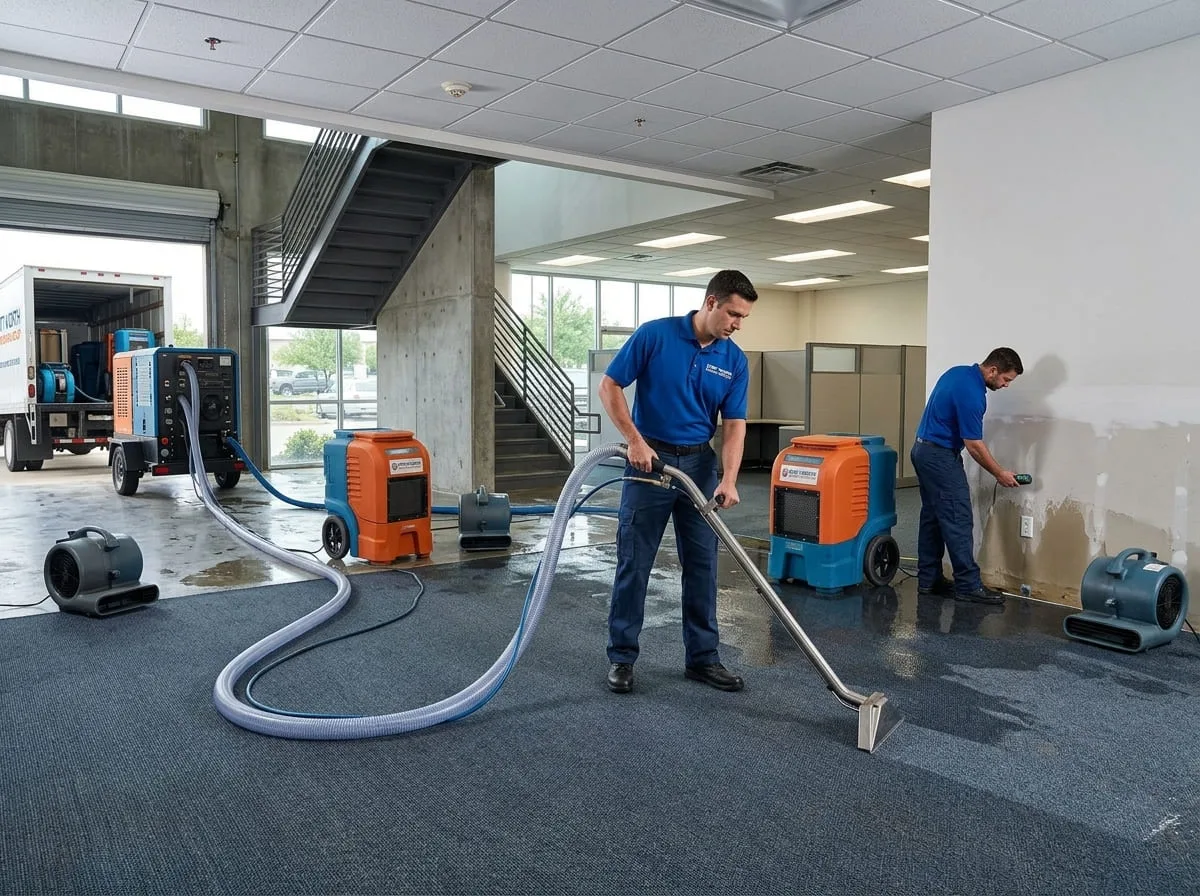
This is where the job sits at the direct overlap of fire and water restoration. The crews responding need extraction and structural drying capability, not just fire and smoke experience, because the suppression water is its own loss inside the larger one.
- Extraction of standing and trapped suppression water
- Moisture mapping behind drywall, under flooring, and inside ceiling cavities — including areas away from the visible fire damage
- Removal of saturated materials that can't be effectively dried
- Air movers and dehumidification equipment to dry the structure
- Ongoing moisture monitoring alongside the soot and smoke assessment
What Happens if the Water Is Treated as an Afterthought
It's an understandable mistake: the fire is the dramatic, visible event, and the water can look secondary by comparison. But water left untreated while attention stays on smoke damage and soot cleanup is exactly how a fire loss turns into two separate, more expensive losses. Flooring that could have been dried in place ends up needing replacement. Drywall that was only wet at the surface has time to wick moisture further up the wall. And in Fort Worth's warm, humid stretches, trapped water inside a wall or ceiling cavity can start supporting mold growth within a couple of days — a separate problem layered on top of the fire and water damage that's already there.
The practical takeaway is that water extraction after a fire isn't optional or secondary. It runs alongside the fire cleanup, not after it, and it covers the full extent of where the water traveled — not just the room that burned.
Residential and Commercial Differences
A house fire typically involves suppression water from a handful of hose lines, concentrated in and around the area that burned. A commercial fire — particularly one where a sprinkler system activated — can spread water damage across an entire floor or building even when the fire itself stayed contained to a smaller space. Commercial property owners should assume a building-wide water assessment is needed after sprinkler activation, not just a check near the fire's point of origin.
Frequently Asked Questions
Is water damage after a fire really as serious as the fire damage itself?
In many cases, yes — sometimes more so. Firefighting water can spread further through a structure than the fire did and cause its own separate damage to flooring, drywall, and contents if it isn't extracted and dried quickly.
How is firefighting water different from a burst pipe or a flood?
The extraction and drying principles are the same, but suppression water can carry soot, ash, and debris picked up on its way through the structure, which affects how it's classified and cleaned up compared to a clean water source.
Can mold really become a concern this fast after a fire?
Under warm, humid conditions with water trapped inside a wall or ceiling cavity, mold growth can begin within roughly 24 to 48 hours as a commonly cited general guideline. That's part of why suppression water gets its own extraction and drying response rather than waiting until smoke cleanup wraps up.
Does insurance cover the water damage from putting out a fire?
Most policies that cover fire damage also cover water damage caused by fighting the fire, since it's a direct result of the same covered event. Documenting the fire and water damage separately helps support the claim — restoration professionals can prepare that documentation as part of the job.
Who handles the water side of a fire loss?
Restoration crews that handle fire losses generally carry both fire-restoration and water-mitigation capability, since suppression water damage is a routine part of the job rather than a separate call.
Don't Let Suppression Water Become a Second Loss
The water used to put out a fire needs the same fast extraction and drying attention as any other water damage emergency.
Get Emergency Water Removal